%20opaque%206-11-24.png)
#30 Streams, Creeks, and Rivers oh My!! is there a difference?

Updated: Jun 9
Stream, Creeks, Rivers Oh my!
As you are learning to fly fish, and by now have watched 100K hours of Youtube videos, read so many on-line articles that your head feels as if it would explode. Let’s add more fuel to the fire and talk about the terms Stream Creek and River. I know what’s the difference is and why does it matter?.
The reason it matters is when you go to a new fishing area, weather it be a new state or new river system, you need a few tidbits of information to help you in deciding hoe to begin to fish this new stretch of water.
I heard it said once as follows:
A Stream you can jump over, a Creek you can wade across, and river you swim across. Jump, Wade Swim is the little Pneumonic for this. I don’t know how true this is, but it’s kind of funny.
The reason you should at least be familiar with these types is, they each have their own uniqueness.

First up is the Freestone Stream:
The water flows of a freestone stream are based on seasonal fluctuations of snowpack, and snowmelt. In the summer and fall, freestone streams grow warm and have reduced flow because water from snow melt is less available. Freestones are supplied by runoff and snowmelt and seasonally adjusted CFS, (cubic feet per second) naturally.
The more snow a location gets in the winter, the more water is reserved for runoff in the spring and summer months. These watersheds will always be affected by run-off due to temperatures and rainstorms.
The reason they are referred to as a “Freestone”, is simply that they “flow free”. I mean no major damns to block the flow of the water, it may have small diversion damns along the way, but nothing significant enough as to hold thousand of acre feet of water.
The reason you should know a freestone when you see one:
On a freestone you will not need to be as specific as to your fly choice. You can use more generalized patterns, fish are accustomed to feeding at any opportunity, they may be less selective as to fly being used. For example, flies like Prince Nymphs, Rubber leg flies, are just big strange looking patterns, I have no idea what Prince Nymph is supposed to imitate, but they work.
Using dry flies’ things like a Royal Wulff, Coachman, or a Humpy may work well as search patterns. You can see you don’t need to get your super geek on for a freestone river. Here in Colorado, we fish the Colorado river, “which is a freestone” in its upper stretches, and frequently use big bushy foam flies like Fat Alberts, Amy’s Ants or any other big fluffy foamy fly. Again, what fish would choose to eat a big chuck of orange and yellow foam with legs?
One more thing to keep in mind regarding freestones, they can be very susceptible to rain and run-off which can turn the water from nice and clear, to muddy toilet water in a matter of 30 minutes or less, due to a high mountain thunderstorm or even raise the water level unexpectedly during summer months.
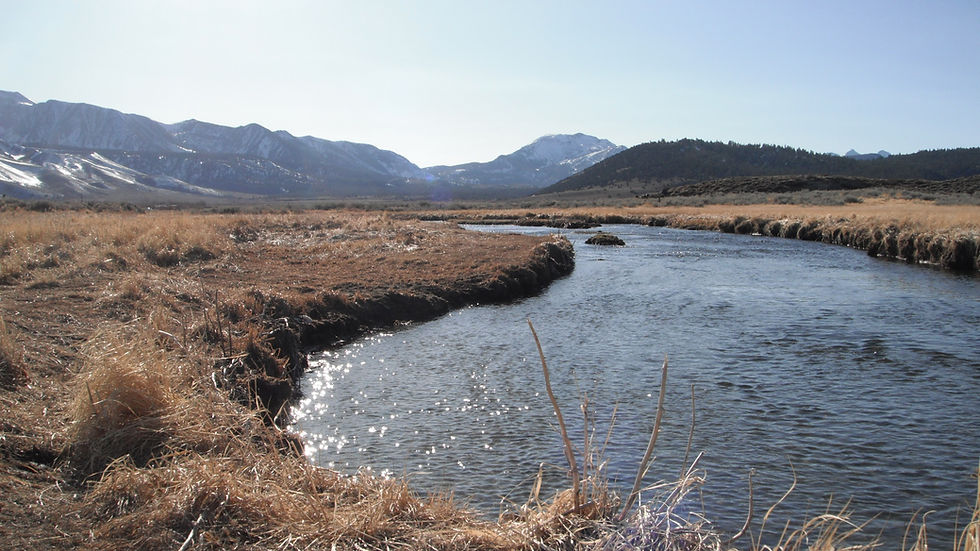
Spring Creeks, the Holy Grail of waters, I don’t mean Monty Python.
Spring Creeks are just like the name suggests, it is a creek that feeds entirely from an underground spring. These watersheds are nutrient rich, usually gin clear and overflowing with aquatic vegetation.
If you have read some my earlier posts, what lives in the aquatic vegetation?......... That’s right, aquatic insects.
I used to guide Hot Creek, which is a spring creek located in the Eastern Sierras of Central California. Hot Creek is feed by underground Geothermal springs, and the weeds are so thick birds can literally walk on the top of them. I would show Clients how prolific the aquatic insects were by reaching in the water and grabbing a handful of weeds and pulling it up, so they could see the hundreds of insects in just that one handful of weeds. What is so great about the weeds? Insects loves weeds, fish love insects, and we love fish?
With all of the insects you get hatches, and I mean hatches. Fish in a spring creek are so dialed into the aquatic insects; you can literally set a clock by the hatches of the day. There can be as many as 3 or 4 different hatches during the course of a single day.
8:00 to 9:30 size 18 Caddis. 9:45 to 11:30 Pale Morning Duns, 13:00 to 15:00 Little Golden Stones (Yellow Sallies) 19:00 to dark, October Caddis. This is just a sample of how a day can go on spring creeks.
The downside to all of these bugs is fish have their PHD, in bug identification. Your fly needs to be right on, I don’t mean close, but right on or you will just spend a day watching fish refuse your fly, time and time again. Are the fish eating emergers?, or adults?, or spinners?, This can change by the minute.
There is an upside though, the more time you spend on these types of waters the better you will become, and I do mean better.
Casting, presentations and fly selection will be on an expediential learning curve. Once you graduate the University of Spring Creeks, with your Fish PHD, you will kick butt on any other water.

Last up is tailwaters, what? Water has a tail:
If the water comes from the bottom of a damn then it has a tail, and this we refer to as a “tailwater fishery”
Tailwater fisheries are those that exist solely due to the influence of a dam at the head of the river, or section of the river, that regulates flow and temperature. In short, tailwater fisheries are there because there's a dam above them. The Green River in Utah for example, the prolific fishery wouldn't be there if it wasn't for the conditions that are created by the consistent water temperatures that are drawn from the bottom of the damn. Damns that draw from the top are generally better for warm water species, like Bass, Catfish, or Strippers, or any other warm water fish.
The great thing about tailwater fishery is the predictability of the river. Since the water flows from the bottom of a damn, the temperatures can be very stable. With stability comes predictability, which is good news for you, because the tailwaters can be very predictable as to time of year of hatching insects. Usually, your best bet is to call ahead to the fly shop on that river or look them up on-line to see the time of year, and insects that predictably hatch at that time. It is never a bad idea to bring a handful of small nymphs as well.
Conclusion:
You can see there is dramatic differences in the three type of waters I have talked about. The reason you should have a basic understanding of these types of water is each will need to be fished specific to that type of watershed. Freestones, get generalized patters whereas spring creek need to be dead ringers, and tailwaters are very predictable.
So do a little homework before you go, get a few of the right flies for that river creek or spring, catch a few fish, and amaze your friends with your newfound knowledge of the different types of watersheds.
Please hit me up if you have any questions or comments.
Cheers
Gary, AKA LaMachine


Comments