%20opaque%206-11-24.png)
#37 Fly Fishing with Dry Flies.

Fly Fishing with Dry Flies, why are they called Dry, If it’s in the water isn’t it going to get wet?.
I thought today I would spend a few minutes talking about fly fishing with dry flies. If you are new to the fly fishing game you may have questions about dry flies. By now even the beginner fly fisherman should know that dry flies are flies that are designed to float and be fished on the surface of the water.
Today we are going to go over some of the different designs and styles of dry flies and how they can be used in different types of water.
Wiki term:
A dry fly is a lightweight fishing lure used in fly fishing. Designed to resemble insects that float on the water's surface, it is constructed with buoyant materials. Anglers cast dry flies to imitate natural prey, enticing fish to rise and strike, creating a visual and exciting fishing experience.
I’m not going to talk about which fly to use or what color to use (talk to your local shops) but rather what style or design to use on different type of water conditions.
Types of designs:
Basically, in the world of dry fly fishing we refer to flies in three different categories. These are Attractor patterns, impressionistic patterns, and finally imitative patterns. ( I know there are people standing up and screaming about others) For this discussion we are going to keep it simple.
Attractors: attractor flies could resemble anything or nothing at the same time? (Confused yet), if you have ever heard of a fly called a “Chubby Chernobyl”? it’s nothing more than a big chunk of foam with hair and legs. It could be a grasshopper or loaf of bread I don’t know but it will get a fish’s attention and if they are in the mood it becomes a snack.
Impressionistic: Flies in the impression group are starting to actually look like a bug, sort of. They might have an upright wing, or a post, tails, they may even have legs on them. The idea is they do look like a food item fish are used to seeing on a regular basis but are not exact copies of insects.
Imitative: this is the last group of flies, and these flies really do look like the aquatic food they are imitating. Flies like these are used when trout are dialed-in on particular form or current life cycle of insects and will eat only that one. (My personnel favorite time). These are made with materials that usually float poorly, but they do look like a real bug, they do the trick.
Ok time for more refrigerator art to help me get the point across:

Style (a) is a what is know as a “parachute” style of fly. They are tied with a post in the center, which is usually calf’s tail, and the hackle is wrapped sideways. The white post is very visible on the surface of the water. This fly floats very well in rough water and is great for fishing “pocket water”. Addams Parachute is a good example of this type of fly.
Style (b) is what is referred to as a “upright and divided wing” these will float nicely on the surface of the water, and the upright wings represent anything with wings. The hackle is tied in a spiral around the shank of the hook. A good example of this style would be “Royal Wulff”.
Style (c) is what could be called a slanted wing fly. These flies are made to represent a specific time in the hatching insect’s life cycle. These flies will not float as well in rough water, because they do not have a bushy hackle, and can be harder to see at a distance. The wings can be made with either deer hair or CDC feathers. A good example of this fly could be a “Compara Dun”.
Style (d) is a “hair wing” fly and is made with wings from hollow hairs like that of deer or elk. Since the wings are made with hollow hair, they are highly buoyant, but you can apply a bit of floatant to the hair and it float really well. As well as floating well in choppy waters they are also very easy to see on the surface of the water. Good example is a “Elk Hair Caddis”
Style (e) is what is referred to as “no hackle”. This style of fly is made without hackle and look almost exactly like the real thing. No Hackles are best used slow moving water where a fish has all the time in the world to look at the fly before deciding to eat it or not. No hackle flies float poorly and are pulled under very easily, so this style is a poor choice in rough water, but good choice in slow waters. Good example of this would be a “No Hackle PMD”.
Style (f) also known as a simulator fly. These new generation flies are tied with synthetic materials like foam, rubber legs, or mylar flash. These foam bodies flies are great at floating high and dry on the surface as well as being really easy to see. Foam flies are great for faster choppy waters, and work well in off color water, due to all of the flashy materials. Foam bodied flies are also great for an indicator fly on the surface, while hanging a small nymph underneath. “Chubby Chernobyle” is a great sample of this type of fly style.
Shape of things to come:
The part you will learn over time is “which style of fly to use on which type of waters”. Examples (a), (b) are tied in a “bushy” style. The bushy hackle will help the fly float high on the water’s surface and be very visible while you are fishing it. The reason this is important is because if you are fishing fast moving riffle or choppy pocket water you should use a very buoyant, and highly visible fly. Other style of flies with less hackle will be pulled under or drowned in a second, making it difficult to see the fly being taken by a fish.
Flies (a) and (b) can be considered attractor style patterns, due to the fact they are merely a generalized shape of an insect. These flies can be a great way to just cast around and see who is interested in a quick meal.
Fly style (c) and ( e) are a more refined shape or profile and will be better served on slower waters, where the surface of the water is smoother, and much clearer, and not as choppy as a fast riffle. This style of fly is for situations where fish are actively and selectively feeding on a certain life cycle of a particular insect. Since these two flies are dressed lightly or with little to no hackle they will ride closer to the water’s surface, and will sink very easily, as opposed to a bushy style. A great example would be a “PMD no hackle”.
Fly style (d) is a hair wing fly and is generally used to imitate a “Caddis” or Stonefly adult. If you look at a real Caddis fly and then an “Elk Hair Caddis” fly you will see that they look very similar. Hair wing flies can float very well in choppy waters, depending on the design of the particular fly you bought. Some have a palmered body hackle, and some do not. Either way you fish them they are a great pattern to grab a hungry trout. Again, a great example is an “Elk Hair Caddis”, or a “Stimulator”.
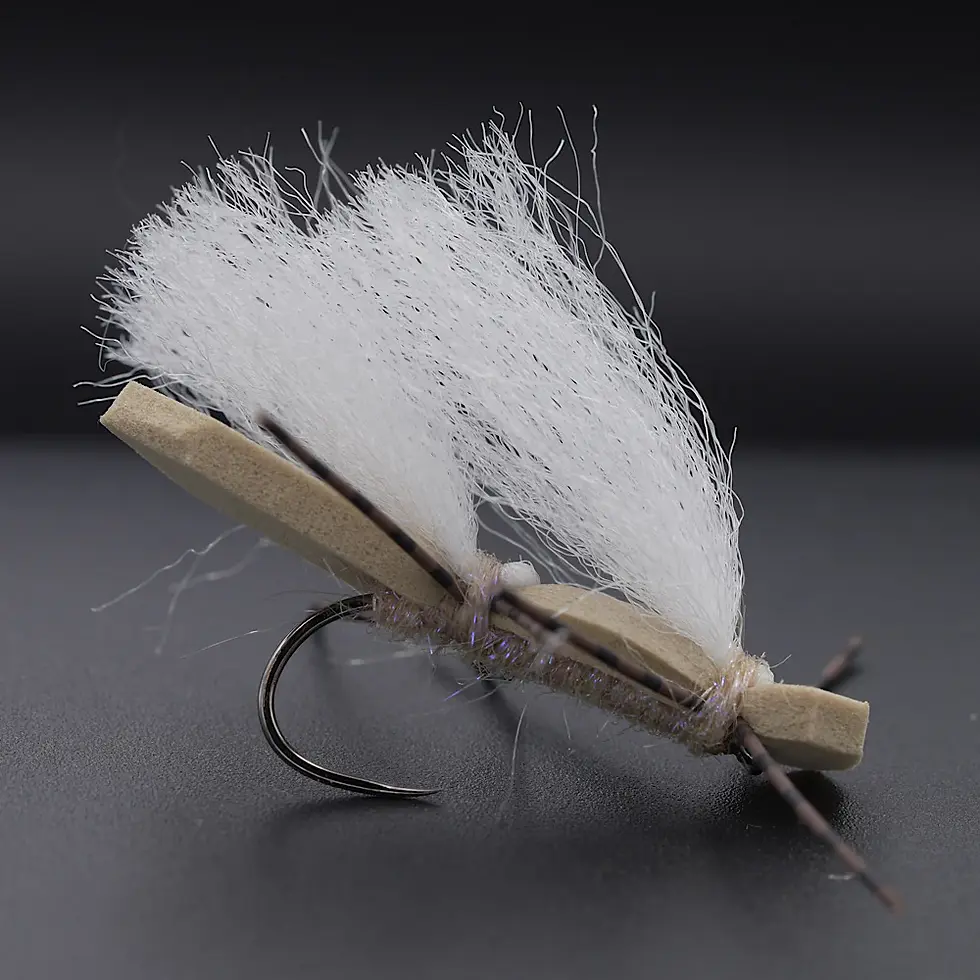
Last but not least is the foam monsters as I call them. Foam flies are getting very popular with fly tyers for good reason, “they work” these floating bombshells are great for fast water, riffles, off color mud water, and undercut banks. The downside to these flies is if you are trying to “match a hatch” fish may tend to look the other way and grab your friends “No Hackle” fly. All kidding aside, there are some really great foam flies being tied and used today, so do not discount them as junky.
What’s the big deal:
For the last few minutes, you have listened to me drone on about dry flies and how each of them function best on different types of waters. Now to get to the meat of this discussion. Let’s take a look at this picture.

If you wanted to throw a dry fly and search some of the pocket water, which style of fly would you start with? If you actually stayed awake for the first part of this post, you could think of this picture and descriptions of the flies. You would need a fly with high buoyancy, and you would want a high visibility pattern. A good choice might be a “Chubby Chernobyle” because the foam body, and white top wing you can see it very well in the choppy water. Can you think of another pattern that could be used to fish this section of water?
Did you think of other patterns that might work to fish this types of water? Maybe a “Stimulator” or a big “Parachute” style fly, something big bushy and high floating. These flies could be a good choice, but don’t listen to me, go out and toss a fly and see how it works.
Now in contrast to the first picture let’s look at this one and see which style of fly you would consider?

If we look at this section of water we can see there is slower water on the edges, and many places where a fish can settle in and slowly and deliberately come up to look at your flies. If the fly is not accurate in size shape and color you can get a refusal. Remember a refusal is when a fish comes up to look at your fly and stops within an inch or two of the fly, drifts back slowly inspecting it, and then just puts their nose in the air, and you get to see your fish just swim away and laugh.
In this slower water you might want to think about the “No Hackle” patterns or the “Slant Wings”, or a "small Parachute" style pattern. These are dressed very lightly, but they are made to look as close to the real thing as possible. Since there is less fast or choppy water the flie does not need as much bouancy.
Now if your fish comes up to inspect your fly, being the right size, right shape, right color, you may just have the “winner winner chicken dinner”. Fishing this type of water takes a little more skill to fish. If you can see the fish in the water, they can also see you. Your approach to flat water needs to be more stealth like, think of yourself as a fishing Ninja.
Let’s put it all together:
I have sent a few minutes blabbing on about the design of flies, and places to fish them, but I have done this for good reason. With your newfound knowledge you will be able to walk up to the edge of a river and give the river a quick look. If you see an abundance of choppy or riffle type water, you might remember some my rants, and you may choose to start with a high vis, high floating fly to begin your search of this section of the river.
Now in contrast if your section of river is filled with slow slues or flats, or slack water, you might start your day with a “no Hackle” style of fly. You will need a pattern that is very close to the real thing, and these flies do not need to be highly buoyant, due to the abundance of slower water.
Thanks for listening to me, and it is my hope that al least one of my little pearls of wisdom might help you to better understand this puzzle we call “fly fishing”
Good luck and have fun out there.
Gary, aka LaMachine


Comments