%20opaque%206-11-24.png)
#33 Learn to Fly fish Still Water, Part 2 of 2

Updated: Jun 9
Learn to Fly fish Still Water Part 2 or Deuce
If you read part 1 of my post on "Learning to Fly Fishing Stillwaters", I hope you have finally recovered from my long and breathy monologue. If you are learning to fly fish for the first time or just want a different option on how to fly fish Stillwaters. There is so much information that is available when it comes to Stillwater fly fishing, I would need to write an entire book, (oh wait there are books)..
If your local Stillwaters happens to be a family farm pond, it will not be that difficult to figure out how to fish it, but if your local pond happens to be a 2,000 acre lake, then it might be more of a challenge to learn how to fish it.
I wrote in part 1, how I would just randomly go to the edge of the water, cast with blind fury at the water until a fish felt sorry for me, and gave up. The other part of the story I did not mention is how upon reaching the shore, how I was utterly overwhelmed at the massive blankness of the water’s surface. In a river you can see rocks, logs, deep slots, but in a lake there is very few clues, until you begin to look closer.
2 miles of shoreline could be as much as 20 acres of water starring into your face and taunting you to find a fish. If you have the courage to hang on through another one of my long monologues, this time we are going to go a little further down the rabbit hole, so hang on. I might be able to help you learn to break down Stillwater into more manageable bites, (get it, bites).
Learning the landscape, or hydroscape:
If you have ever been to a lake at any time in your life, you will have no doubt stood on the shore and looked out upon the water’s surface, what did you see? Could you see underwater rock piles, weed beds, or drop offs? probably not, unless you have Superman x-ray vision. No, we just see acres of flat water surface, so where do we fish?. Good question we are going to learn how to break down a lake even before we get to the lake.
Some of you may already be familiar with Topographic maps (or Topo Maps) used for hiking, well guess what you can also get for lakes as well. For those that do not know what a Topo map is, a topo map is a map of contoured lines of either mountains or in this case a lake. Lake topo maps show riverbeds, cliffs, high spots, and shallows, all with the use of contour lines. Take a look at the 2 examples below, one is from a map I use for my local lake, the other is a screen printed out from a navigation system. Both relay the information by using lines to tell the story.
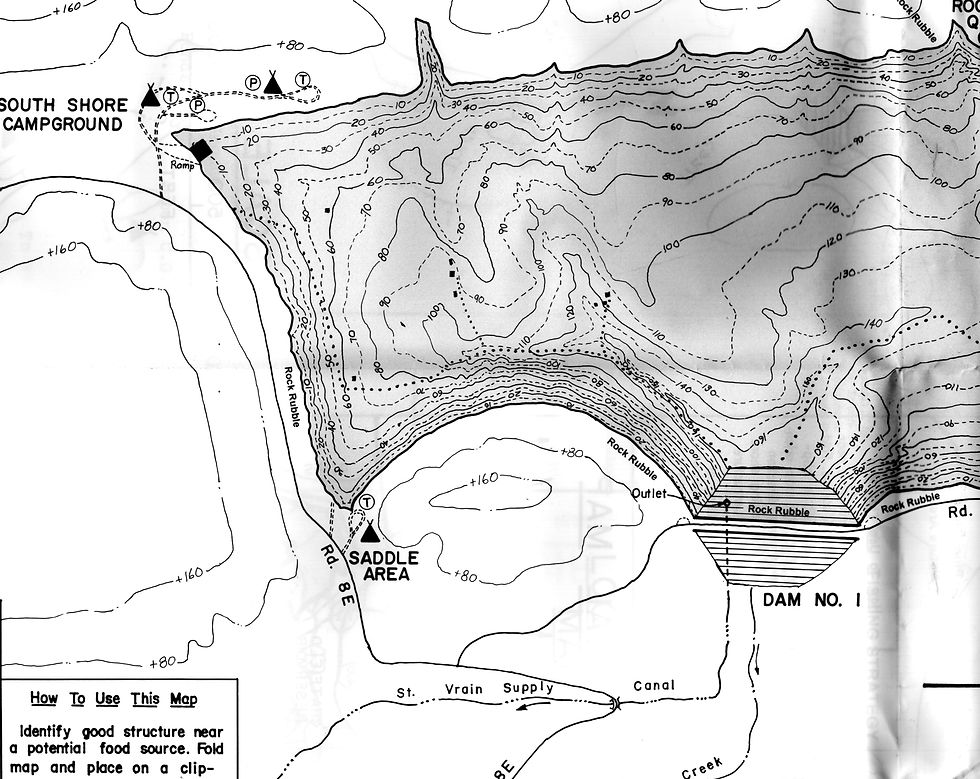
If you look at example #1you can see that most of the main area of the bay is sloped away from the bank, but the area near the dam is a very steep drop. Look at example #2 you can see a steep drop that comes up to a gradual sloping shoreline. If you remember in part 1 we talked about weeds and where they grow. Do you think weeds will be present near the gradual drop on map #2, or the steep drop on map #1?
Hopefully you said map #2 for the win! But I think you can see from my cheesy example that you can improve your chances of success even before you leave the comfort of your house. Look at the maps, see where the best areas to fish are from the maps, and then go to the lake, and fish those areas. You might be in for a big surprise.

Current and which way the wind blows:
Believe it or not, lakes have very active current movements under the surface of the water. Current, or movement of the lake water can come from places like outflows of the lake, or a feeder creek that flows into the lake, but there is one big one that most people miss and that is wind.
Wind will move the surface water in the direction of the wind, but most people do not know that when the moving water hits the shoreline it then reverses direction, causing the below surface current to go the opposite direction, (HUH). Take a look at yet another cheesy piece of artwork to better understand this concept.

“Why do I care which way the waters move” well it is good information because when the wind blows on the water, it can concentrate food in certain places on the lake. You may have wind blowing into a cove and thus concentrating micro plankton into that cove. Micro plankton is food for small fish, and small fish are food for big fish. So, let’s do the math, more food equals more fish, see how this is all connected?
So far so good?
Now that you have a little more information on how to read water, let’s look at some of the different equipment you can use to fish Stillwater. Originally we talked about just using a floating line for those who are starting out and trust me this will catch fish.
Later in the year when waters heat up, and there is less oxygen in the water, fish will look for deeper and cooler areas of the lake to hang out in. Your floating line will not be as effective to fish these deeper section of the lake. So, let’s give a big hearty welcome to the sinking line, (Tada).
Sinking lines:
We are not talking about corny lines people use at a nightclub, but rather a line that will literally sink in the water when you cast it out. Sinking lines are made like a regular line, they have a strong core, and outer coating, but the outer coating is a very dense material that will is heavier than water and therefore sinks. These lines are rated to sink at different rates, for example, Scientific Anglers lines are rated by the rate they sink or (inches per second), IPS.
Type I = 1.5-2.25 ips
Type II = 1.75-2.75 ips
Type III = 2.5-3.5 ips
Type IV = 4.00-5.00 ips
Type V = 4.5-6.00 ips
Wow that’s a bunch of numbers! But it really is not that hard to learn. For example, you can cast out a Type III line and once the line is on the water it begins to sink, simply start to count, 1,2,3,4,5,6, seconds and then figure (6 seconds X 3 ips = 18 inches or about 1 ½ feet deep.) double the count to 12 seconds and you can fish around 3 feet deep +/-, and so on. This will let you fish different depth of a lake.
Why can’t I just use my floating line and weight?
Well, you actually can use a floating line and a weight, however floating line and sinking lines will not act the same when underwater. A floating line will want to pull your fly upward as you are stripping the fly back in, while the sinking line will stay under the surface at a more consistent level, beholding the artwork again.

Exception to every rule:
Let me show you a way you “can use” your floating line in a very effective way to catch fish that may be in deeper water, and that is the floating strike indicator. Yes, just like the one we use in rivers for nymph fishing. You will need a leader that is 9 to 12 ft. long, a section of tippet, a weighted fly and a smaller fly and of course a strike indicator. The indicator you can adjust the depth of the rig to the water depth you are fishing.
You are going to cast this rig out in front of you, and hopefully in a fishy area. You will have to let the entire rig slowly sink down until everything is directly under the indicator, and then with short and slow strips, you will pull in 3 to 4 inches of line at a time. This will cause the midge to slowly rise up in the water column and then sink back down slowly. It is this up and down motion that will mimic a midge trying to rise to the surface of the water, or a fish will see the wooly bugger or leech that is just along for the ride, either way it is a good way to catch a fish, but can be a little boring at times, because the retrieve is rather slow for my short attention span.

Casting, it always goes back to casting:
In prior post we have gone over the basics of learning to cast a fly rod, and basic mechanics of casting. Learning to fish Stillwaters is where the rubber hits the road. If you have not yet perfected your casting skills, and you are trying to cast out into a lake, you will only magnify faults in your casting. The fish will always be 5 to 10 feet further than you are able to cast, and you will do the same thing I used to do, and that is (of course) just need more power! Trying to cast farther by casting harder simply will not work. Just learn to fish in an area you can comfortably reach, over time your casting will improve and will be able to cast farther out, or you could go buy a “float tube”. Well talk about tubes later on.
Enough talking “PLEASE”.
I hope that you were able to stay awake long enough to actually retain some of the information I spouted out. I hope that the next time you plan to go to a lake to fly fish, you can do a little homework, learn the best areas to start and be able to use the right equipment, and land a “giant chunk of a fish”
Good luck and as always feel free to reach out to me with any questions or to yell at me for the long posts.
Cheers
Gary AKA LaMachine


Comments