%20opaque%206-11-24.png)
#5 Fly Lines for Fly Fishing
- Gary Fiala
- Jun 4
- 6 min read

Updated: Jun 9
Fly lines for Fly Fishing demystified, hopefully?

I thought today we would take a deep dive and Geek out, and spend a few minutes talking about fly lines themselves, instead of talking about learning to cast, or learning to fly fish. If you are going to become that ACE on the water, you should at least know a little bit about the tools of the trade.
Let’s talk about the basics first, as to what a fly line really is. Well, a fly line is a line made up of two basic components.
First you have the core of the line which is usually a braided material such as Dacron or some other type of braided material. The reason for the core is twofold, first is the strength of the core. Fly lines will break but the breaking strength of a fly line is HUGE, anywhere from 20-30 lbs. of breaking strength depending on the weight of the line. You can break a fly line, but your leader or some other terminal tackle would fail first.
The second part of the fly line is the outer coating. This is created to incorporate microscopic air bubbles inside of the coating to “trap air”. This trapped air is what gives a fly line its ability to float, (if designed to.) This coating is also what gives the fly line its characteristics that are in the design, I.E., “weight forward” or “double tapper” or “shooting tapper”. All these terms refer to the shape design and intention of the fly line.
Here’s some of the Geek stuff I was referring to, so let’s talk a little bit about the history of fly lines themselves. Fly lines began sometime in the 1700’s when fly lines for dedicated anglers were made using horsehair. The hair was braided together to form a line. Most of the horsehair lines were made for “dapping or dipping”, which was simply dangling the fly over the water until it touched down. These early lines we not suitable for casting as we think in today’s terms, but “hey” it got the job done.
Sometime in the early 1700’s anglers and line makers began mixing silk within the horse hairs to improve durability and line strength. Sometime after, many anglers discovered this material and began to use single strand lines all over the country and by the early 1800’s the silkworm gut lines market flourished.
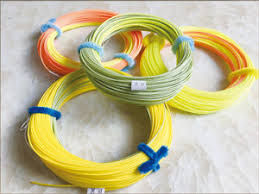
Fly lines and their history started to get interesting again in the early 1900’s. When Chemists from Dupont Laboratories created a new synthetic material known as “Nylon” These materials would not only revolutionize fly fishing, but the world today.
Another major development in the evolution of the modern fly line occurred during the early 1940’s when Leon P. Martuch decided to try to find an easier way to make a tapered fly line. With a background in chemistry from his association with Dow Chemical Co., and a good measure of curious inventiveness, he devised a method of making a tapered fly line by forming a tapered coating over straight level braid. Later, he formed a new company called Scientific Anglers, located in Midland, Michigan in 1945. Around this time the first modern floating line was produced.
One more major development in the construction of fly lines is slickness agents. When it comes to slickness, essentially, it allows manufacturers to alter the properties of different polymers to build a better fly line – essentially more flexible and durable. Most lines today are built with a PVC or polyurethane coating which are widely produced using synthetic materials with slickness, and textured coating added to the lines. Textured coatings? You say, what’s that. Well, it is microscopic coating on the surface of the fly line which helps the fly line to pass through the guides, to produce less friction, and in theory more distance. New coatings on the surfaces in today’s market, and anglers are getting a higher quality product compared to prior generations.

Now if you’re reading and watching videos on how to cast, or how to learn to fly fish, you will repeatedly hear the terms “5 weight, 6 weight, 3 weight”, what exactly does that mean to you the new fly fisherman. The term “weight” is going to always refer to the weight of the fly line itself. A fly line will have specific weight in “grains.” And each line will have a basic required weight. If we look at the chart below hopefully you will get a better understanding of the term “weight” as it refers to fly fishing.
You can see that a 2-weight line should weigh about 80 grains, and a 7-weight should weigh about 185 grains. There is a big difference between the two in terms of available weight or mass of line to cast, remember we are casting the weight of the line not the lure. You read this and say, “what is a grain”, well great question. A grain is a unit measured by weight. Let’s look at the conversions here:
15.4 grains = 1 gram
28.3 grams = 1 ounce

Now that you are bored to tears reading on and on about fly lines, here is a few more nuggets of knowledge for you tender minds.
The differences in fly line weight can cause confusion to the new fly fisherman who might think that any good line matching the rod's line rating will be the optimal choice. It's not like your fly rod won't perform at all if you don't choose the line with the best grain weight, but the right line allows the rod to perform at its very best. This is why it's always important to not just look at the line weight number but read the line's description and find out the physical grain weight so you can see where it fits into the AFFTA chart.
(The American Fly-Fishing Trade Association (AFFTA) represents the community of fly-fishing businesses aligned around the sustainable growth of fly fishing)
Now that you are a master of line weights and line construction, let’s talk about the shape or design of modern fly lines.
If you look at the following diagram, you can get a better understanding of as to the shape or design of a modern fly line. Let’s discuss the two different models for a minute.

Double taper line used to be the industry standard, because they were very versatile and economically sound. When over time you had worn out the end of the of the double taper line you could simply take it off and reverse it, and you had a new line once again. On of the draw backs of a double taper is its difficulty to make longer casts. Due to the weight of the “belly” of the line you gave up distance, but you still had accuracy, and so gave birth to the “weight forward line.”
The weight forward and the double taper both are 90 ft. in length, both have a synthetic core material, both have a PVC coating on the line, however the real difference is in the shape of the lines design. A weight forward line is designed to have the weighted portion of the line “forward” so that once you start to cast you have the weight of the fly line out of the guides sooner, which translates into better distance with less effort.
On a foot note, keep in mind that, casting with a double tapered line might make casting for the beginner fly fisherman easier to learn in the beginning of their journey, but as your casting skills progress, you will over time graduate to the weight forward design.
As you begin to look at purchasing your first line you will see on the packaging the following codes, no its not a secret code, but the codes for fly lines.
DTF= double taper floating
WFF= weight forward floating
RTF= rocket taper floating
WFST= weight forward sink tip
This is what you will see on the side of the box when you purchase your first fly line.
It is my hope that this information will help demystify the learning curve when it comes to learning how to fly fish. So, take this newfound knowledge and go and impress your friends, and teach someone else the essentials of a fly line. I know we went on a little bit of a deep dive here, but this type of information will again begin to build your foundation of knowledge, your pillars of success that you need as you venture forth into your future as a fly fisherman.
Hit me up if you have any questions or comments I love to hear what people are saying.
Cheers
Gary, AKA LaMachine



Comments